
Zhuoyu Wu
Reagan · 吴卓宇 / PhD Student, Monash University

Efficient intelligence, from algorithms to hardware.
I am a PhD student in the CyPhi AI Lab at the Monash University, supervised by Prof. Raphael Phan, and funded by Graduate Research Excellent Scholarship. Currently, I am also a visiting PhD student at Peking University under the guidance of Prof. Daquan Zhou.
Prior to Monash, I have worked on Efficient AI algorithm design as well as the SW/HW co-design under the guidance of Assoc. Prof. Dr. Zheng Wang and Dr. Wenqi Fang at Shenzhen Institutes of Advanced Technology, Chinese Academy of Sciences(SIAT, CAS). I had a wonderful time there, collaborating with a group of talented individuals to deliver several key projects.
I care about making research reproducible and practical to deploy. As a member of IAPR Technical Committee 22 on Reproducible Research in Pattern Recognition (TC22), I welcome exchanges with researchers who share these interests and encourage interested colleagues to explore TC22’s activities.
If you are interested in any aspect of me, I am always open to discussions and academic collaborations. Feel free to reach out to me at — zhuoyu.wu [at] monash.edu
-
 Monash University
Current · PhD student
-
 SIAT, CAS
Previous · Research collaboration
-
 Peking University
Current · Visiting PhD student
Research Interests
- Efficient AI
- HW/SW co-design
- LLM
- AI for Science
News and Updates
A compact research log: ⚙️ efficient AI / hardware, 🖥️ GUI agents, and 🎓 personal milestones.
Scroll for all updates · 2026–2023
2026
- ⚙️ Oct 2026: TernScope: Model-Hardware Co-Design for Efficient Ternary Endoscopic Segmentation is now available on arXiv, featuring W2A8 ternary quantization and an 88.46% reduction in compute-array area. [Preprint] [Code]
- ⚙️ Oct 2026: AGQ: Action-Guided Ultra-Low-Bit Quantization for Vision-Language-Action Models is now available on arXiv, achieving 92.7% LIBERO success at W3 and up to 6.10× model compression. [Preprint] [Code]
- ⚙️ Oct 2026: Our paper, “VAULT: A Secure FPGA Inference Accelerator for RRAM-Inspired Biomedical Edge Intelligence,” has been accepted for an oral presentation at the IEEE International Conference on Microelectronics (ICM 2026). VAULT explores an RRAM-inspired approach to enhancing the security of FPGA-based biomedical image segmentation at the edge.
- ⚙️ Aug 2026: Two papers were accepted by BMVC 2026: LiteUAV-DETR, which studies scale-aware feature routing for real-time UAV detection, and Motion-Equivariant Pseudo-Video Augmentation, which targets video-style generalization from a single static polyp dataset. [LiteUAV-DETR] [Pseudo-Video Augmentation]
- 🏅 Aug 2026: DepthPolyp received the ICPR 2026 Reproducible Research in Pattern Recognition (RRPR) Badge, following a separate positive peer-review evaluation of its reproducibility, transparency, code, and data availability. [Badge Criteria] [Paper] [Code]
-
🎓 Aug 2026: I was selected as a recipient of the IEEE Computer Society WEIGD Student Support Fund, as one of 502 selected applicants. [Award]
- ⚙️ Aug 2026: Lightweight Polyp Segmentation via a Gain-Aware Prediction-Space Recursive Controller was accepted by ICONIP 2026 as a Poster paper. The work introduces a compact, host-portable controller that recursively refines backbone logits with minimal deployment overhead. [Preprint] [Code]
- ⚙️ Aug 2026: RoiMAM was accepted by APSIPA ASC 2026. This work proposes a region-of-interest medical attention mechanism for efficient vision-language understanding, enabling compact yet effective medical visual question answering. [Preprint]
- ⚙️ Aug 2026: RIGS-Refiner was accepted by APSIPA ASC 2026. This work introduces a lightweight prediction-space refinement framework for robust colonoscopy polyp segmentation, improving segmentation quality with minimal computational overhead. [Preprint] [Code]
- ⚙️ Jul 2026: DepthPolyp in Practice was accepted by the Sixth Workshop on Reproducible Research in Pattern Recognition (RRPR 2026). This companion work expands the technical and reproducibility details of DepthPolyp and delivers a real-time iPhone inference and deployment framework. [Program]
- ⚙️ Jun 2026: Edge-Segstar was accepted by Biomedical Signal Processing and Control (BSPC, Q1). This work explores bidirectional self-distillation to improve efficient medical segmentation models, aiming to better balance the trilemma among model size, accuracy, and inference speed. [Paper]
- ⚙️ May 2026: RoiMAM was released on arXiv. This work introduces a region-of-interest medical attention model for efficient vision-language understanding, focusing on lesion-relevant regions to improve medical visual question answering with a compact model. [Preprint]
- ⚙️ Apr 2026: DepthPolyp was accepted by ICPR 2026. A pseudo-depth guided lightweight segmentation model for real-time colonoscopy, achieving 3.57M parameters, 0.86 GMACs, and over 180 FPS on mobile devices. [Paper] [Code] [HF Model] [HF Demo]
- ⚙️ Jan 2026: EndoCaver was accepted by ICASSP 2026. This work improves segmentation under fog, blur, and glare by connecting image restoration with the visual attention used for segmentation. [Preprint]
2025
- ⚙️ Nov 2025: FLICKER was accepted by DATE 2026. We reveal fine-grained sparsity in 3D Gaussian Splatting and design a contribution-aware reconfigurable accelerator for real-time 3DGS. [Preprint]
- ⚙️ Oct 2025: TMU was accepted by IEEE TVLSI. This work builds near-memory tensor manipulation capability for data-move-intensive, compute-light operators. [Paper]
- ⚙️ Sep 2025: RT-Focuser was accepted by ICTA 2025 as an Oral paper. A lightweight real-time deblurring model for edge-side vision, exceeding 140 FPS on mobile devices. [Paper] [Code]
- 🎓 Aug 2025: I began my PhD journey at Monash University.
- 🖥️ Jul 2025: GUI-Narrator was accepted by ACM MM 2025. This work studies how to detect and caption computer GUI actions for multimodal agents. [Paper]
- ⚙️ Apr 2025: AttenPU was accepted by GLSVLSI 2025. An area-efficient attention processor with reconfigurable FP8 precision and bidirectional dataflow. [Paper]
- ⚙️ Jan 2025: PR-KAN was accepted by ISCAS 2025 as an Oral paper. To the best of our knowledge, this is the first FPGA accelerator dedicated to Kolmogorov-Arnold Networks (KANs). [Paper]
Earlier
- ⚙️ Sep 2024: Fourier-LSTM was accepted by ICTA 2024. We embed Fourier transforms into LSTM to improve DNA sequencing accuracy on portable devices. [Paper]
- 🖥️ May 2024: GUI Action Narrator was publicly released. This work uses VLMs and pre-grounding to support GUI action understanding across platforms and applications. [Paper] [Code]
- ⚙️ Apr 2024: Harmonizing U-Nets was accepted by Computers in Biology and Medicine (Q1, IF=7.7). A cascaded design with adaptive attention fusion for efficient low-quality OCT fluid segmentation. [Paper]
- ⚙️ Apr 2023: COMPACT was presented at DATE 2023, focusing on precision-adjustable nonlinear activation acceleration. [Paper]
Academic Service
Technical Committee Member
IAPR TC22 · Reproducible Research in Pattern Recognition
Reviewing & Programme Committees
-
Journal:
- Information Sciences (Q1) – Reviewer
- Biomedical Signal Processing and Control (Q1) – Reviewer
- MEDICAL & BIOLOGICAL ENGINEERING & COMPUTING (Q2) – Reviewer
- Frontiers in Digital Health (Q1) – Reviewer
- Frontiers in Cell and Developmental Biology (Q1) – Reviewer
- Applied Computational Intelligence and Soft Computing – Reviewer
-
Conference:
- ISCAS 2027 – Reviewer
- ICASSP 2027 – Reviewer
- BMVC 2026 – Reviewer
- RRPR 2026 –Programme Committee
- IJCNN 2027 – Reviewer
- ACMMM Dataset Track 2026 – Programme Committee Member
- ACMMM 2026 – Reviewer
- MICCAI 2026 – Reviewer
- WCCI 2026 – Reviewer
- ICASSP 2026 – Reviewer
- BMVC 2025 – Reviewer
- IJCNN 2025 – Reviewer
Keynote Works
Selected projects in efficient models, practical deployment, and multimodal understanding.
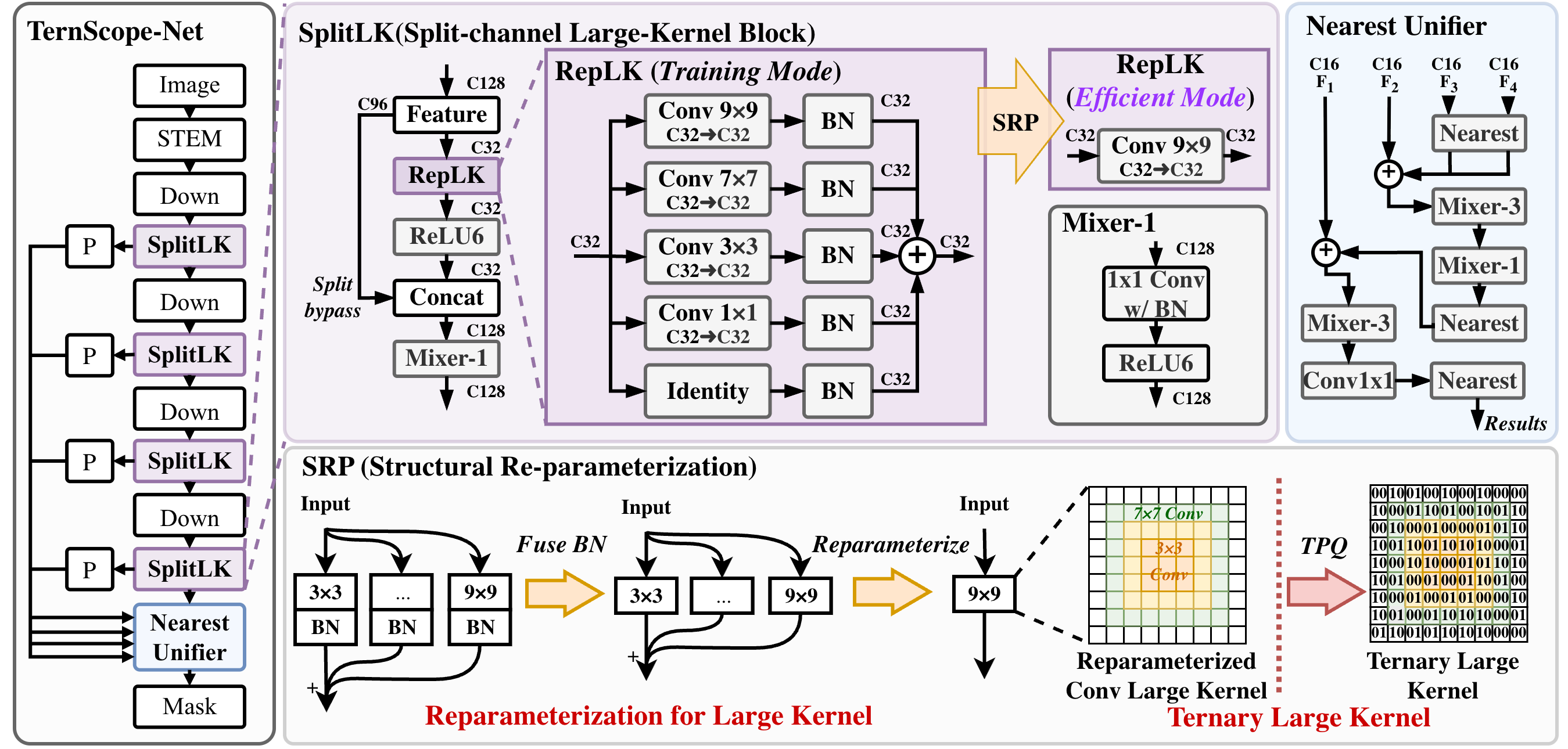
Architecture figure from the project repository
Model–hardware co-design
TernScope
A ternary endoscopic segmentation model co-designed with an accelerator, connecting low-bit inference with efficient hardware.
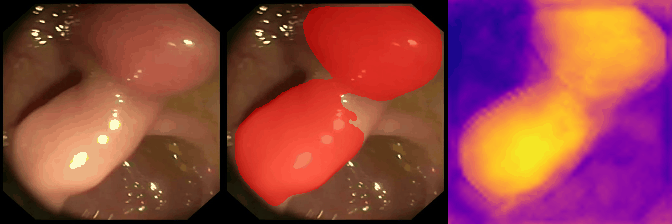
Still from the repository segmentation demo
Medical vision & deployment
DepthPolyp
Lightweight colonoscopy segmentation with pseudo-depth guidance, including ONNX inference and an open-source iPhone Core ML demo.
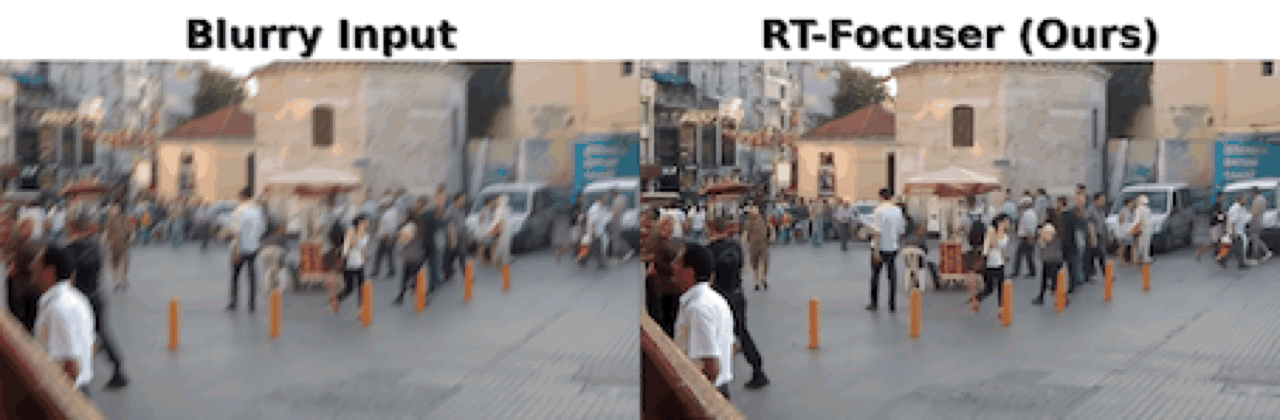
Still from the repository deblurring demo
Real-time edge vision
RT-Focuser
A lightweight image deblurring model for real-time edge deployment, with training, inference, and mobile deployment resources.
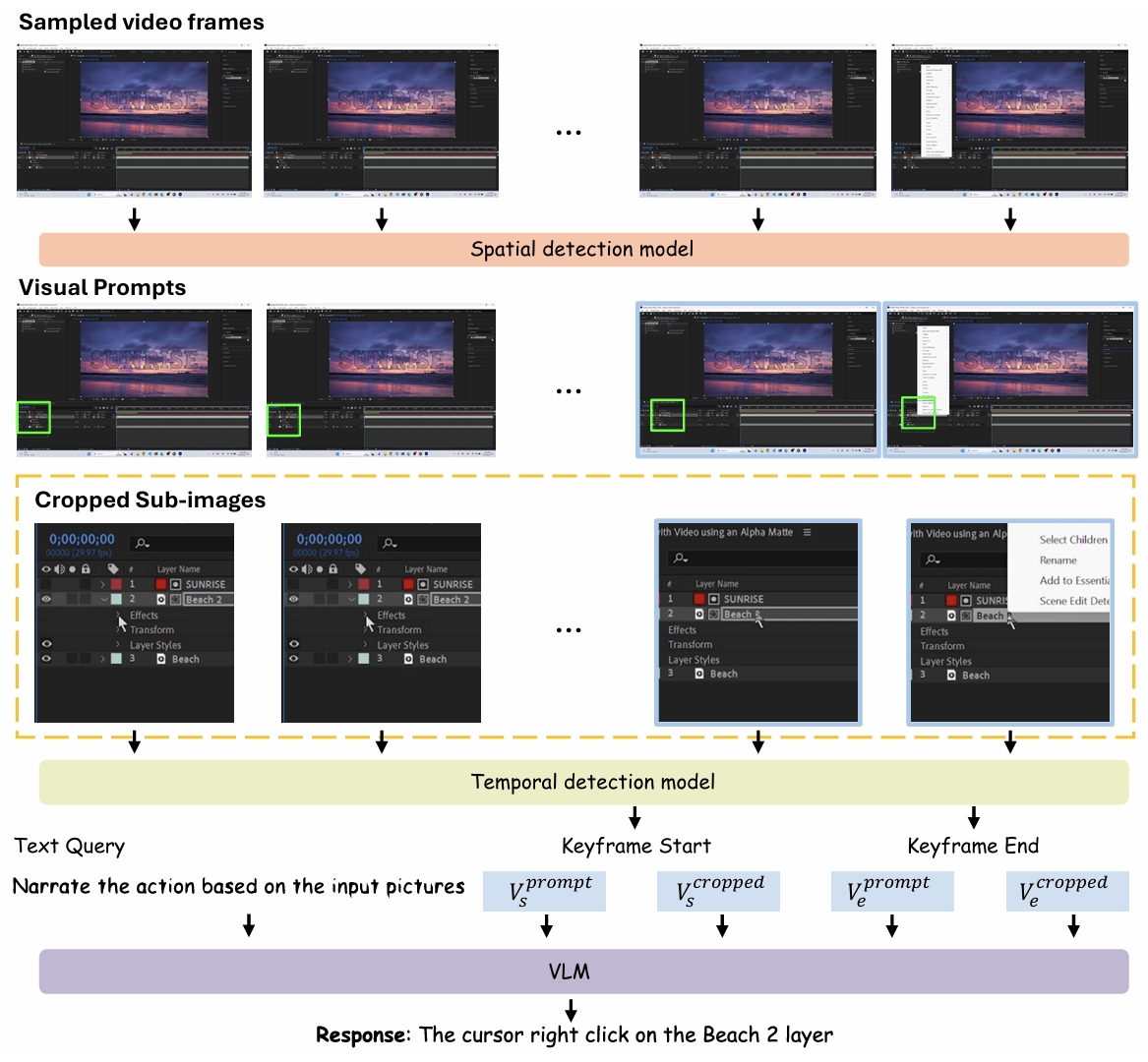
Pipeline figure from the project repository
Multimodal GUI understanding
GUI-Narrator
A GUI action captioning framework and the Act2Cap dataset, using cursor detection and keyframe extraction to interpret on-screen actions.